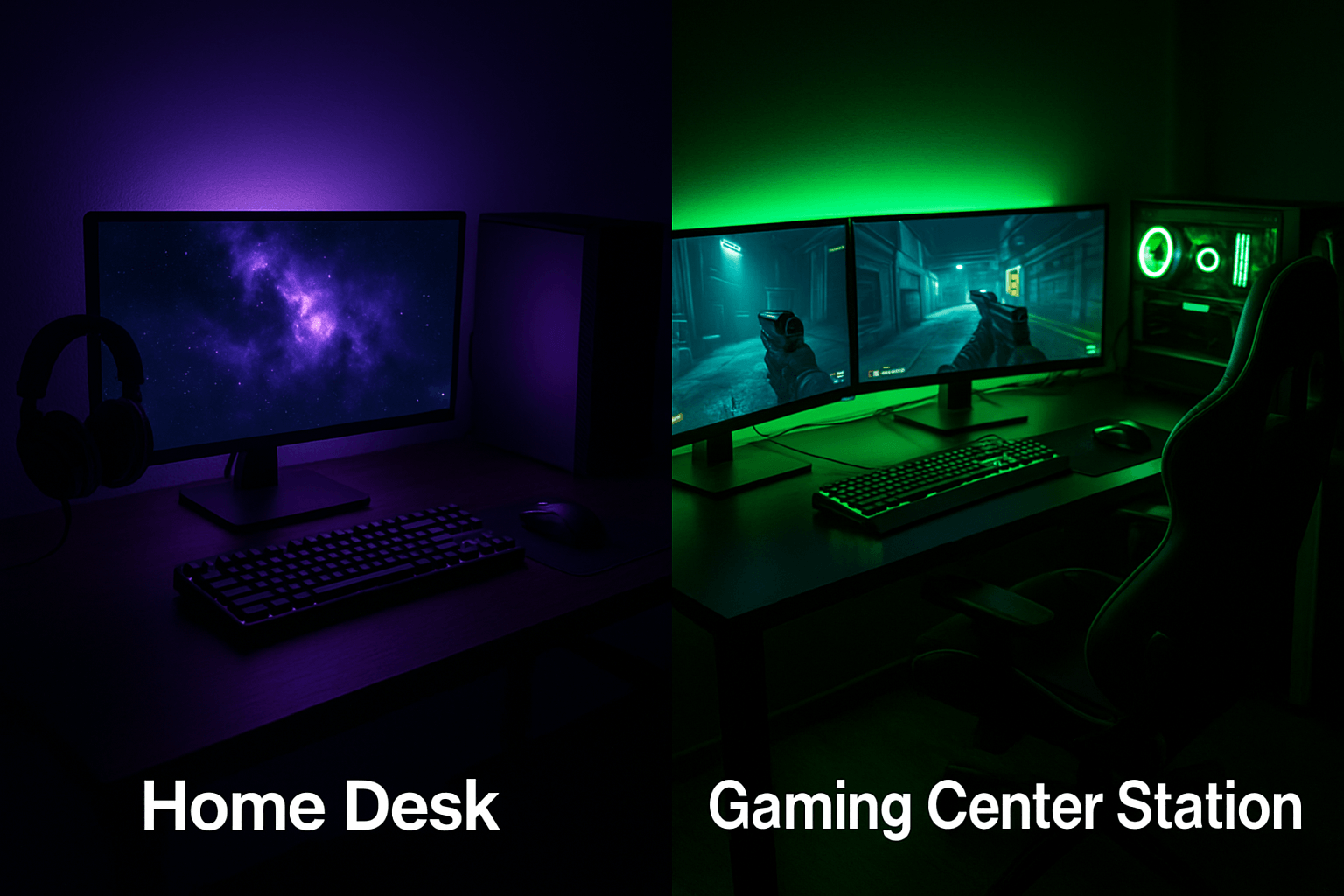
The question we hear most often
Someone comes in for the first time, looks at our PC stations, and says: "These are nice, but mine at home is basically the same spec." They're often right. RTX 4080, 32GB RAM, 1440p monitor — a lot of our target audience has a comparable setup at their desk. So why are they here?
I've asked this directly to members who come regularly. The answers are consistently more interesting than "better hardware."
The physical presence of other people changes the experience
This sounds obvious but it's genuinely underrated. Playing a competitive game while someone you know is physically sitting next to you — or someone you've just met is commentating from behind you — is a categorically different experience from playing through Discord. The feedback loop is faster, the social energy is immediate, and the stakes feel different.
One of our regular members said something that stuck with me: "I can play Valorant at home every night of the week. But there's something about sitting next to someone who's also in the game, watching them react in real time, that I can't reproduce alone in my room." That's not a hardware problem. That's a social infrastructure problem that a gaming center solves.
The context switch matters
Your home setup is also your work setup, your study setup, your distraction setup. The same chair you use for eight hours of work is the chair you're sitting in to relax. For a lot of people, there's a mental overhead to transitioning between those modes in the same space.
Coming somewhere specifically to game — leaving the house, making a decision — creates a clear boundary that can actually improve the quality of the session. This is the same reason people go to the gym instead of doing home workouts even when they have home equipment. The context is part of the experience.
Hardware you don't have at home
This applies specifically to VR and the console setup. Most people don't have a Valve Index or Meta Quest 3 at home, and even fewer have four of them in a dedicated play space. The console zone with OLED TVs is also something that most people's living rooms can't replicate — not because of cost, but because a 55-inch OLED in a dedicated gaming room with proper acoustics is different from one in a shared living space.
Even for PC: our 165Hz OLEDs are perceptually different from a standard IPS at the same spec. People who play here regularly on monitors they haven't used before sometimes notice things they didn't expect to notice.
The tournament and community layer
Organised competition with real opponents who are physically present is something you simply can't replicate online. When we run a Valorant tournament or a Street Fighter bracket, the dynamic in the room is different from anything that happens over a headset. People who play completely differently under those conditions — some players are noticeably better, some are noticeably worse, and almost all of them describe it as more memorable than online matches.
The community that forms around this is also real. A significant portion of our regulars met through events here and now coordinate outside of the venue. That's not something The Respawn Place created — it's something the physical shared context made possible.
When it doesn't make sense to come here
If you want to grind solo for a ranked climb, do it at home. If you want to play something that takes eight hours and requires your specific mod configuration, do it at home. If you want to be in your pajamas, do it at home. These are all legitimate ways to use your home setup and we're not in competition with them.
What we offer is specifically the thing that's harder to get in a bedroom: people, physical presence, space, and organised events. If that's what you're looking for on a given night, we're here.