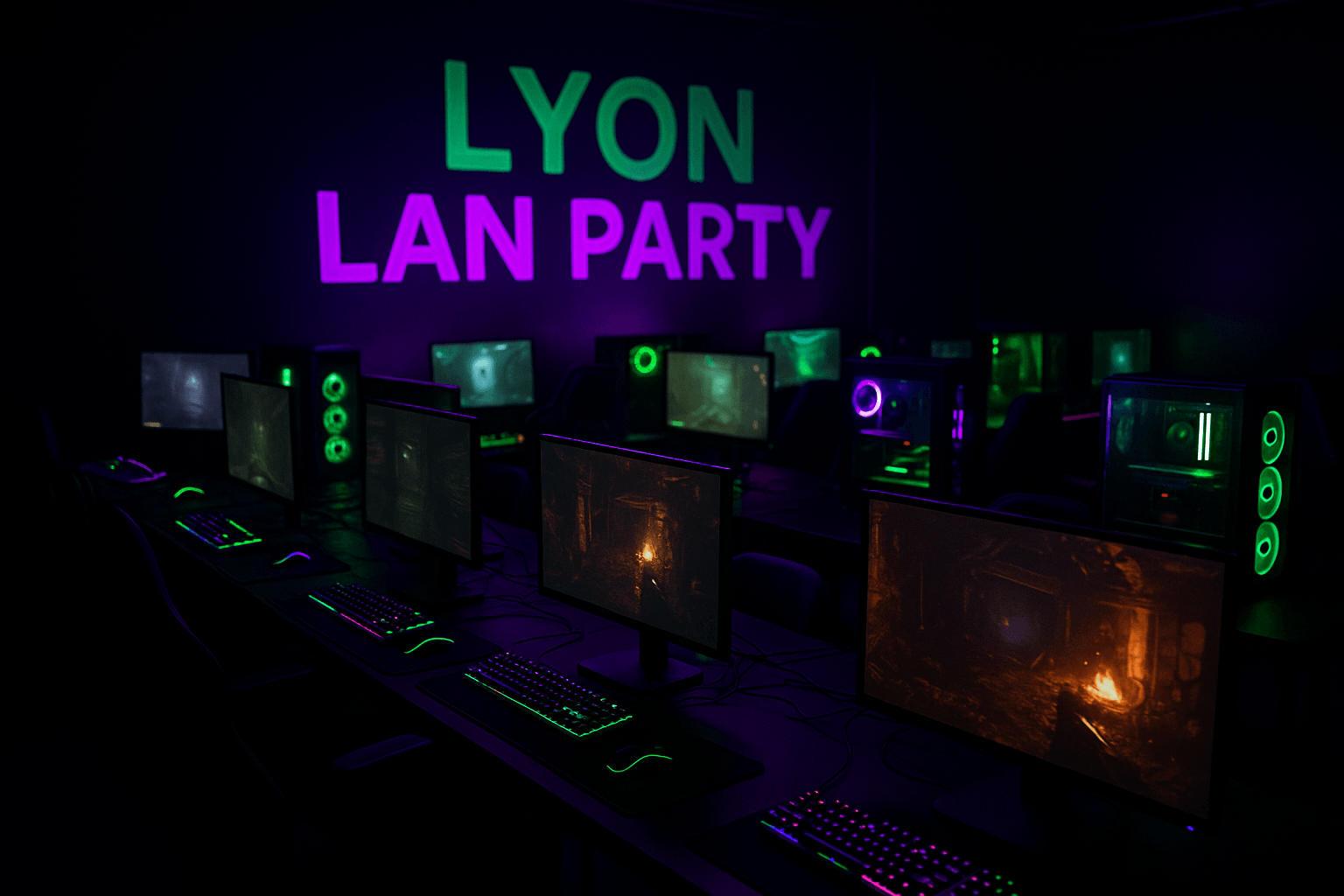
The main problem with most LAN parties
Most LAN parties fall apart not because of hardware — they fall apart because of coordination. Someone shows up late, someone doesn't have the game, someone wants to play a title that requires three other players who don't own it, someone's laptop can't actually run the thing. Before you know it, half the group is watching the other half play.
The good news is that these problems are all solvable before the day. What follows is what we've learned from running these regularly — both officially at The Respawn Place and, before that, when Luca and I were organising them at people's apartments.
Choosing a venue in Lyon
Your options in Lyon fall into a few categories. You can host at someone's apartment, which works fine up to about 6 people before it gets logistically complicated. Above that, you're looking at cable management, extension cords, and one person hogging the bathroom.
Dedicated gaming spaces handle the hardware problem completely — you show up, the machines are there, you don't have to brief anyone on how to configure their network settings. The tradeoff is cost: you're paying hourly per person, but for a group of 10 or 12 people that's often cheaper per head than you'd expect, especially on a weekday evening.
A third option is renting a meeting room and bringing your own hardware. This works for groups that are all bringing high-end laptops or small form-factor builds, but the logistics overhead is significant and the network setup can be genuinely painful.
What to look for in a venue
Space per person matters more than people expect. You want enough room that people aren't bumping elbows, and that there's somewhere to put a drink that isn't directly next to a keyboard. Acoustics matter too — a tiled room full of 12 people playing different games is genuinely unpleasant after an hour.
The network setup is critical for any game that requires LAN connectivity. If you're doing something over the internet it matters less, but for actual local multiplayer you want low-latency routing and ideally wired connections. WiFi LAN parties have a specific kind of suffering associated with them.
Picking games the whole group will actually play
This is where most LAN parties run into trouble. The game selection conversation usually happens the day before, someone posts three options in the group chat, nobody responds, and then on the night you end up playing whatever the loudest person wanted.
The approach that works: pick one anchor game that everyone agrees on ahead of time, then have a fallback list. The anchor game should have a low skill floor and not require extensive setup — something people can jump into within five minutes without reading a tutorial. Games like Among Us, Rocket League, Jackbox Party Pack, or older multiplayer titles that everyone half-knows tend to work well as anchors.
For the more experienced part of the group, you can have a separate bracket running in parallel. We've had groups where half the people are doing a Valorant tournament and the other half are on the consoles doing something more casual. It sounds chaotic but it works fine if the space allows it.
Games that reliably work for mixed groups
Low barrier to entry, high fun ceiling: Rocket League remains excellent for this. EA Sports FC if you have football fans. Tekken or Street Fighter if anyone wants to teach others — fighting games have a nice teaching dynamic. Minecraft still works for a group that hasn't played it together before. Overcooked is chaos in the best way and requires no prior gaming experience.
For groups that are mostly experienced: CS2 or Valorant for FPS, any of the Civilization series if you have a longer window and people who want something slower, Starcraft 2 if anyone's nostalgic and wants to embarrass themselves publicly.
Logistics: the part everyone skips
Set a clear start time and add 30 minutes for reality. If you say 7pm, people arrive at 7:15 and are set up by 7:45. Plan around this rather than against it.
Sort food and drinks before the gaming starts, not during. Once people are in a game, stopping to order pizza creates a 20-minute break that breaks momentum. Either have food ready when people arrive or plan an explicit break at the two-hour mark.
Designate someone to manage the bracket if you're doing one. Tracking who plays who on a whiteboard or even a phone works fine, but someone needs to be responsible for it otherwise it collapses after round one.
Finally: set an end time. LAN parties without an end time tend to bleed indefinitely until one person leaves and it becomes awkward. Having a clear finish — even if you run over by an hour — gives the evening a shape.
If you're booking with us
When you book the private lounge, tell us your rough headcount and what kinds of games you're interested in. We can pre-configure the stations so everything's ready when you arrive — no setup time, no installing updates mid-session. If you want a bracket, let us know and we'll have it ready on screen.
The lounge fits up to 20 people and can be set up as a mix of PC and console stations depending on your group. We've had LAN parties that were all PC, all console, or a split — all work fine. The minimum booking is two hours, and most groups end up adding an hour once they're in.